Showing posts with label Christ. Show all posts

Tuesday, January 5, 2016

Guest Post
By Kevin Merrell 
In Need of a Revelation About the Book of Revelation
Once we take the Book of Revelation seriously, what are we to make
of the casserole of curious metaphors that populate it?
Container or contents?
In the movie, The Princess Bride, Wallace Shawn plays Vizzini, a self–important little boss in a trio of bumbling outlaws. Mandy Pitinkin plays another of the outlaws, Inigo Montoya, a Spanish fencing master intent on revenging his father’s death. Despite his belief that he’s an unusually clever person, Vizzini is fond of saying that unlikely events are “inconceivable!” Once after he says this, Inigo thoughtfully replies, “You keep using that word. I do not think it means what you think it means.” The same could be said for a word that showed up as far back as the Book of Revelation or The Apocalypse of John in the Bible. The word, apocalypse, is a part of our modern written and visual vocabulary to describe the world as we know it collapsing into chaos, suffering and destruction, right? Yes and no.
While the dictionary indeed defines apocalypse as “a great disaster: a sudden and very bad event that causes much fear, loss, or destruction”, the word has its origins in the Greek word, apokalypsis, simply meaning “to reveal or uncover”. It’s as if the word, apocalypse, was a jug full of chocolate milk. At one time the word, jug, meant a container for liquid and the words, chocolate milk, meant chocolate–flavored milk. Over the course of thousands of years, however, the word, jug in this case has taken on the meaning of its contents, the chocolate milk. There is great value in separating the container of the revelations of John from its contents of prophecies about the judgments of God in the last days.
This is revelation
The first verses of the Book of Revelation open with a bold statement announcing this separation of container from content and inviting our attention and further study:
1 The Revelation of Jesus Christ, which God gave unto him, to shew unto his servants things which must shortly come to pass; and he sent and signified it by his angel unto his servant John:
 2 Who bare record of the word of God, and of the testimony of Jesus Christ, and of all things that he saw.
 3 Blessed is he that readeth, and they that hear the words of this prophecy, and keep those things which are written therein: for the time is at hand. (Revelation 1:1–3)
In verse one we learn that John’s revelation is actually Jesus’ revelation and as with all matters divine, it originates with God. Will we heed the mind and will of the Lord? By way of assignment a messenger or angel has guided John through the revelation. In verse two we learn that the Book of Revelation is John’s testimony or witness of Jesus Christ and the events of the last days that were shown to him. In verse three we discover that a blessing is attached to reading, hearing and abiding by the words of the revelation. The phrase, “for the time is at hand,” adds a note of urgency mirroring Jesus’ own urgency when he taught his apostles about the last days.
The gift of a divine message
In the Book of Mormon we learn that others, including Nephi the son of Lehi, have experienced this same comprehensive, panoramic vision of the human story seen by John:
25 But the things which thou shalt see hereafter thou shalt not write; for the Lord God hath ordained the apostle of the Lamb of God that he should write them.
26 And also others who have been, to them hath he shown all things, and they have written them; and they are sealed up to come forth in their purity, according to the truth which is in the Lamb, in the own due time of the Lord, unto the house of Israel.
27 And I, Nephi, heard and bear record, that the name of the apostle of the Lamb was John, according to the word of the angel. (1 Nephi 14:25–27)
Nephi is forbidden by an angel to write an account of the vision of all things because it is the task of another. John, the apostle of the Lamb of God, has been ordained to share this testimony and revelation with us. Other prophets have been shown the same vision but their records are sealed up to come forth in a future day of the Lord’s choosing. The Book of Revelation is the gift of a divine message to us, a testimony of Jesus Christ and a witness by divine decree to the events unfolding in the last days. What faithful person would not be drawn in study and prayer to John’s revelation? Will God not hold us accountable for what we do with such a gift?
“Plain and pure”
Even a casual reading of John’s Apocalypse, however, raises an additional but perplexing question: if the Book of Revelation is a specially-prepared testimony of Jesus and of end time events, why, oh why, does it feel so obscure and mysterious to us? With its jambalaya of curious beasts, books, seals, trumpets, colors and sounds, the book reads in places like some kind of fever dream or hallucination.
Remarkably, in the opinion of the angel teaching Nephi about the vision, John’s record is plain, pure and easy to understand:
Wherefore, the things which he [John] shall write are just and true; and behold they are written in the book which thou beheld proceeding out of the mouth of the Jew; and at the time they proceeded out of the mouth of the Jew, or, at the time the book proceeded out of the mouth of the Jew, the things which were written were plain and pure, and most precious and easy to the understanding of all men. (1 Ne. 14:23.)
“Well, of course it’s clear to an angel,” we think to ourselves, “Without the veil to cloud his understanding it’s easy for him to understand John’s vision.” While that’s undoubtedly true there’s also a possible clue for us in the text. The angel notes that “at the time the book proceeded out of the mouth of the Jew, the things which were written were plain and pure.” Like many parts of the Bible the story may well have gotten muddled in transcription and translation before it got to us.
Working on the puzzle
Even if we’re stuck with a clear story that took a beating when it went through repeated translations, yet there are pieces to the puzzle that we might piece together for ourselves. For instance, when we read about the opening of the sixth seal (the sixth thousand-year period of the earth’s mortal probation) in Revelation 6:12–16 we see a tremendous earthquake followed by lights out and everyone ducking for cover:
12 And I beheld when he had opened the sixth seal, and, lo, there was a great earthquake; and the sun became black as sackcloth of hair, and the moon became as blood;
 13 And the stars of heaven fell unto the earth, even as a fig tree casteth her untimely figs, when she is shaken of a mighty wind.
 14 And the heaven departed as a scroll when it is rolled together; and every mountain and island were moved out of their places.
 15 And the kings of the earth, and the great men, and the rich men, and the chief captains, and the mighty men, and every bondman, and every free man, hid themselves in the dens and in the rocks of the mountains;
 16 And said to the mountains and rocks, Fall on us, and hide us from the face of him that sitteth on the throne, and from the wrath of the Lamb:
In verse 13 we’re not sure what to make of stars falling to the earth yet in verse 15 we read that everyone from the high and mighty to the lowest of the low are trying to find a cave to take refuge in. Why? Something is falling out of the sky on them. Could the word stars in this case perhaps mean meteorites? Later in chapter eight we read of hail and fire falling from the sky and burning up a third of the earth’s vegetation. Could the word hail in this case mean meteorites again? Hundred–pound burning rocks falling out of the sky makes more sense than 100–pound hailstones falling out of the sky. Also it’s a stretch to imagine fire and ice coming down at the same time much less burning up great swaths of vegetation around the world.
Continuing on in Revelation 8:8–9 we read of something described as a mountain falling from the sky into the sea causing the water to become as blood, rendering it toxic to all aquatic life. Where have we heard of water being turned to blood, rendering it poisonous before? The story of Moses and the plagues of Egypt. There are a number of similarities between the plagues of Egypt and the judgments of God found in the Book of Revelation. Because God always uses natural means to accomplish his purposes it’s not unreasonable to imagine him using the same natural forces in both scenarios. One of the striking similarities among all scriptural accounts of the last days is a connection to the heavens. Something dramatic always appears in the sky or falls out of the sky.
“One of the plainest books”
It’s one thing for an angel to declare the Book of Revelation to be clear and easily understood by all but what are we to make of Joseph Smith’s declaration to a conference of the Church on April 8, 1843 that, “The book of Revelation is one of the plainest books God ever caused to be written”? (History of the Church, 5:342.) What? Did the prophet of this, the final dispensation of the fullness of times, receive the same vision of all things seen by John, Nephi, Moses, Enoch and the Brother of Jared? Joseph never claimed that he did but anything he received from the Lord could help us decipher the Book of Revelation.
In fact as Joseph Smith was translating the Bible he had a question-and-answer session with the Lord about the Book of Revelation that is preserved in the Doctrine and Covenants as Section 77. A pattern quickly emerges in D&C 77 that John is telling the story using symbols
3 Q. Are the four beasts limited to individual beasts, or do they represent classes or orders?
A. They are limited to four individual beasts, which were shown to John, to represent the glory of the classes of beings in their destined order or sphere of creation, in the enjoyment of their eternal felicity.
 4 Q. What are we to understand by the eyes and wings, which the beasts had?
A. Their eyes are a representation of light and knowledge, that is, they are full of knowledge; and their wings are a representation of power, to move, to act, etc. (D&C 77:3–4)
Find me a code book
Describing one thing as another thing is a rich, poetic form called metaphor that resembles using code words or a specialized vocabulary. For instance, instead of saying there was so much dust in the air that the moon looked red, we read in several places in scripture that there will come a time in the last days that “the moon will turn to blood.” In fact there is an entire sub–genre in scripture called apocalyptic literature that includes, besides the Book of Revelation, sections of Daniel, Ezekiel, Isaiah, Habakkuk, Mark 13, Matthew 24, 1 Nephi 13–14 and D&C 88. These passages written by different prophets at different times and in different places all refer to the last days using similar if not the exact same metaphors. Perhaps part of our challenge in grasping the Book of Revelation or apocalyptic literature in general is learning this prophetic language. We’d benefit from a code book or a Rosetta Stone to help us make sense of all those metaphors. If Joseph Smith proclaimed the Book of Revelation one of the plainest of all books, he probably understood this prophetic language of metaphors.
Remarkably, LDS researcher Anthony E. Larson claims to have discovered robust, workable insights mirrored by non–LDS scholars that unlock the metaphoric language of the prophets. He’ll be the first to state he’s not a prophet but he does make good use the same gifts of reason and prayerful study that we’ve all been given and invited to use. Through books, a blog, an excellent series of on–line courses and a Facebook page, Brother Larson connects us with both the seemingly supernatural, miraculous stories from ancient scripture as well as the events of the last days foretold in scripture. Check out Anthony Larson’s take on prophetic language and decide for your self.  http://mormonprophecy.com/
“One grand sign”
Joseph Smith taught that it is not God’s intention for us as the children of the light to be caught off guard by the events of the last days:
The coming of the Son of Man never will be—never can be till the judgments spoken of for this hour are poured out: which judgments are commenced. Paul says, ‘Ye are the children of the light, and not of the darkness, that that day should overtake you as a thief in the night.’ It is not the design of the Almighty to come upon the earth and crush it and grind it to powder, but he will reveal it to His servants the prophets. (Joseph Smith, Teachings of the Prophet Joseph Smith, 286).
More useful news: God reveals his design for the last days to his servants the prophets. Already Joseph Smith and Nephi have helped us better understand the Book of Revelation. By knowing about the events of the last days we can recognize in faith the hand of God when his judgments come instead of concluding that he has forgotten us, or worse.
And there’s more. Continuing his insights about the end times Joseph shared with us the grand sign of the second coming of Christ:
Judah must return, Jerusalem must be rebuilt, and the temple, and water come out from under the temple, and the waters of the Dead Sea be healed. It will take some time to rebuild the walls of the city and the temple, and etc.; and all this must be done before the Son of Man will make His appearance.
There will be wars and rumors of wars, signs in the heavens above and on the earth beneath, the sun turned into darkness and the moon to blood, earthquakes in divers places, the seas heaving beyond their bounds; then will appear one grand sign of the Son of Man in heaven. But what will the world do? They will say it is a planet, a comet, etc. But the Son of man will come as the sign of the coming of the Son of Man, which will be as the light of the morning cometh out of the east (Joseph Smith, Teachings of the Prophet Joseph Smith, 286–87).
 Thank you, Joseph, for the grand sign of the second coming!

“Unfolded in the eyes of all the people”
Finally, let’s give Moroni the last word and add him to the list of the Lord’s servants the prophets that can help us better understand the Book of Revelation. In the book of Ether the Lord speaks to Moroni of the revelations of John:
15 Behold, when ye shall rend that veil of unbelief which doth cause you to remain in your awful state of wickedness, and hardness of heart, and blindness of mind, then shall the great and marvelous things which have been hid up from the foundation of the world from you—yea, when ye shall call upon the Father in my name, with a broken heart and a contrite spirit, then shall ye know that the Father hath remembered the covenant which he made unto your fathers, O house of Israel.
 16 And then shall my revelations which I have caused to be written by my servant John be unfolded in the eyes of all the people. Remember, when ye see these things, ye shall know that the time is at hand that they shall be made manifest in very deed.
 17 Therefore, when ye shall receive this record ye may know that the work of the Father has commenced upon all the face of the land. (Ether 4:15–17)
More clues! Our veil of unbelief, hardness of heart and blindness of mind are all part of the problem. It doesn’t mean we’re bad people it just means our traditions of understanding the Book of Revelation and the last days prevent us from actually understanding them. All of us can humbly call upon the Father in the name of Christ and seek to understand the Book of Revelation the best we can. As we do there’ll come a time when everyone understands the revelations of John, and when that happens, the events themselves will manifest shortly thereafter. Furthermore, as we’ve already received the record of Moroni we know that the work of the Father has commenced. It feels like we’re right in the thick of things now. We feel empowered to go out and study the Book of Revelation.


Wednesday, October 23, 2013

The Forgotten Promise


We may have overlooked a significant promise given us by a prophet of God.
Moroni, writing his own observations in the Book of Ether, had this to say to us, the members of the modern church:

Come unto me, O ye house of Israel, and it shall be made manifest unto you how great things the Father hath laid up for you, from the foundation of the world; and it hath not come unto you, because of unbelief.

Behold, when ye shall rend that veil of unbelief which doth cause you to remain in your awful state of wickedness, and hardness of heart, and blindness of mind, then shall the great and marvelous things which have been hid up  from the foundation of the world from you—yea, when ye shall call upon the Father in my name, with a broken heart and a contrite spirit, then shall ye know that the Father hath remembered the covenant which he made unto your fathers, O house of Israel.

 And then shall my revelations which I have caused to be written by my servant John be unfolded in the eyes of all the people. Remember, when ye see these things, ye shall know that the time is at hand that they shall be made manifest in very deed. (Ether 4:14–16, italics added for emphasis.)

In these verses, Moroni seems to be saying that the day will come when John’s enigmatic Revelation in the New Testament, also known as the Apocalypse of John, will be fully understood.

Is that possible? Well, if Moroni is to be believed, it must be.

That begs the question, is it understood now? Some Mormons might be tempted to say yes, that Christian ministers and teachers, including some LDS scholars who say essentially the same things, have managed to wrest the intended meaning from John’s peculiar imagery.

Certainly, numerous efforts have been made down through the years to decipher the message John penned two millenia ago. And despite the seeming unanimity Christian scholars appear to have developed regarding its interpretation—including concepts such as the Rapture, the Battle of Armageddon and the Antichrist—the fact remains that the Savior told Joseph Smith in his First Vision that none of their teachings were correct. If that was so then, it is equally true now. Furthermore, consensus should never be mistaken for correctness.

Still, far too many church members have failed to perceive that the Lord’s condemnation of Christian doctrine in that First Vision also includes their popular interpretation of John’s prophecy. Again, if they were wrong about prophecy in Joseph Smith’s day, they must still be wrong today because their interpretations of it have changed little. In this author’s opinion, most of them have been misguided.

I have elsewhere noted that many church members and scholars have imprudently adopted the mainstream Christian or Millennialist view of Revelation. This has taken LDS thinking on the subject down a dead end path. Revelation is therefore as much a “sealed book” for us as it is for any Christian scholar.

That leaves thoughtful Latter-day Saints to wonder when and how Moroni’s prophecy will be fulfilled. Will the time come when we can read and fully understand the meaning behind John’s curious and seemingly unfathomable imagery?

Until recently, no methodology has been proposed that would allow anyone to truly “unfold” John’s enigmatic writings. But a way to do so may now be at hand. Clearly, Joseph Smith understood the book. He called it “the plainest book.”

Let me make this bold assertion: One need not be a prophet to read and understand the revelations of the prophets—both ancient and modern, John’s included—with all their arcane and bizarre imagery. Anyone can read those revelations as easily as they read a newspaper or magazine, given the proper training.

How is that possible, you say? Let’s look at this together.

Curiously, the only way to properly and understandingly read John’s writing is, in this author’s opinion, with a thoroughgoing comprehension of the cosmological metaphors he employs. The very element we see as a stumbling block is the key to deciphering the text. This is my assertion: All the enigmatic imagery John used in his great Apocalypse (Revelation) in the New Testament is based in cosmic imagery, the common denominator in all ancient cultures and religions.

We see this cosmic symbolism everywhere in ancient cultures, from their myths and legends to their sacred traditions and religious iconography. Certainly, it is on display for all to see in their monuments, temples and texts. To our eyes, it looks like paganism, the worship of cosmic gods and goddesses, chaos monsters and world threatening dragons. But a careful parsing of those riotous images and conflicting imagery, looking back into the past at the original archetypes and motifs instead of the later variations and elaborations, we discover a commonality that is otherwise hidden. That commonality became the common denominator for prophetic imagery.

As it turns out, John’s seemingly indecipherable book is a missionary tract, intended for investigators and new converts. John rehearsed all the primary themes of ancient religious lore from his day to illustrate how it fit into the new religion of Christ and to lay claim to ancient roots for the new Christian religion. It was a conversion tool, used to persuade pagans who held these cosmic traditions as sacred that Christianity honored, respected and incorporated their former beliefs and traditions, that they were all intended to point to and culminate in Christ.

Revelation, then, is more of a rehearsal of past catastrophic events and the cosmic images that went with them than it is a prediction of the future. There’s where mainstream Christianity went wrong. We believe John was looking primarily to the future in his tome, when he was, instead, looking to the sacred, cosmic traditions of the past.

So, Nibley was right. “Cosmisim,” as he dubbed it, is a key component of the Restored Gospel, just as it is in John’s Revelation. Upon serious consideration, how could it be anything less? We encounter cosmic imagery at every turn in Mormonism: in Doctrine and Covenants, in The Pearl of Great Price (especially there), in the Book of Mormon, in the teaching of Joseph Smith and on the exterior walls of our modern temples and in our sacred endowment. It is the cosmological side of the Restored Gospel.

Yet today’s Mormons eye the concept of sacred symbolism with suspicion and misgivings. Like their Christian cousins, today’s church members, for the most part, see sacred, cosmological symbolism as either inconsequential, having no real merit, or a satanic effort to distract us from the teachings of Christ, a perversion of truth, foreign to the gospel of Jesus Christ and the antithesis of Christianity.

So in that context, would it be heretical to suggest that the revised view of prophetic pronouncements espoused by this author, using cosmological imagery from hoary antiquity, is the very mechanism by which, as Moroni declared, John’s Revelation will be “unfolded in the eyes of all the people”? There is only one way to know for sure: Put it to the test. Study these concepts and then apply them.

 “And then shall my revelations which I have caused to be written by my servant John be unfolded in the eyes of all the people.”

Isn’t it a bit curious, in light of Moroni’s words, that most Mormons still do not understand John’s Revelation? Yet, with the cosmological key, the book becomes “the plainest book,” as Joseph Smith declared it to be. It can then be read like any other document, word by word, verse by verse, with nearly complete comprehension.

I know this much: One need not be a prophet to read and understand the revelations of the prophets, with all their arcane and bizarre imagery. Anyone can read Revelation as easily as they read a newspaper or magazine, as long as they employ a knowledge of the archetypes and motifs of ancient cosmological imagery.

There are hundreds of Latter-day Saints who can now do so because they have taken the time and made the effort to master the imagery and symbolism of the ancients and the prophets.

Would you care to be one of them?

Monday, November 17, 2008

The Origin of the Sacrament

Mormons partake of the Sacrament in remembrance of the Savior’s sacrifice for our sins. These are a precious few moments in which we can reflect upon and ponder what he accomplished on our behalf.

All Christians, no matter how they celebrate the expiation of Christ, recognize the instigation of that ordinance by the Savior during the Passover (Pesach) in Jerusalem just prior to his crucifixion.

And as they were eating, Jesus took bread, and blessed it, and brake it, and gave it to the disciples, and said, Take, eat; this is my body.
And he took the cup, and gave thanks, and gave it to them, saying, Drink ye all of it;
For this is my blood of the new testament, which is shed for many for the remission of sins. (Matthew 26:26-28.)

If they pay attention in classes, Latter-day Saints will have learned about the historical roots of Passover in the events of the Israelites’ Exodus from Egypt, which included a hastily consumed meal that came to be known in Jewish tradition as Seder.

Since Seder includes the ritual consumption of certain foods, it seems appropriate that Christ would choose that occasion to instigate another eating ritual to encourage his followers to recall his primary mission to Earth: the resurrection of all and salvation for those who seek it.

Looking deeper into the past

Christians believe that the Sacrament originated with Christ. Hence, no investigation of the ordinance goes beyond that point.

What most Christians and Latter-day Saints do not know is that the origins of the Sacrament, like most Christian conventions, are to be found much further back in time, in ancient custom and tradition. In fact, there is credible evidence that its roots go much deeper into ancient tradition than most consider. This evidence points to the source of such rituals in the heaven-spanning specters that once dominated Earth’s skies.

As it turns out, the scriptures tell us of a ritual meal consumed by idolatrous Israelites that is clearly a prototype of the Sacrament, leading to the surprising conclusion that the Savior borrowed a custom or tradition that was already ancient in his day, and then adopted and adapted it to use as an ordinance.

To understand the ancient origins of the Sacrament, we must go back in time to the reign of judges in Israel after the conquest of Canaan and the Philistines by Joshua’s armies.

Shortly after Joshua’s death, the Israelites began worshipping the gods of their neighbors. In Judges we read:

And the children of Israel did evil in the sight of the LORD, and served Baalim:

And they forsook the LORD God of their fathers, which brought them out of the land of Egypt, and followed other gods, of the gods of the people that were round about them, and bowed themselves unto them, and provoked the LORD to anger.

And they forsook the LORD, and served Baal and Ashtaroth. (Judges 2:11, 12, 13.)

And the children of Israel did evil again in the sight of the LORD, and served Baalim, and Ashtaroth, and the gods of Syria, and the gods of Zidon, and the gods of Moab, and the gods of the children of Ammon, and the gods of the Philistines, and forsook the LORD, and served not him. (Judges 10:6.)

Here we have an unequivocal statement that the Israelites adopted the idolatrous worship of neighboring cultures. Indeed, one might argue that they never actually abandoned the beliefs and practices that they learned while in bondage in Egypt.

Even though the generation that followed Moses out of Egypt had long passed away by the era covered in Judges, the text clearly indicates that they passed on to their children a tendency to accept idolatrous beliefs and practices, suggesting that vestiges of idolatry bridged the gap from one generation to another, down through the ages.

On the earth, as in heaven

Of course, we’ve learned elsewhere that those idolatrous traditions were based entirely in ancient astral events. They were symbolic of things that were once seen to happen in Earth’s tumultuous skies.

More specifically, we know that Baal (Apollo) was Mars and Ashtaroth (Ishtar, Aphrodite) was Venus, the two primary actors in the Polar Configuration.

These idolatrous practices flourished over time to become an integral part of Israelite culture. Indeed, they endured on into the epoch of the Israelite monarchy where Yahweh was no longer revered as the only god. In fact, he was worshipped as one of many gods.

For Solomon went after Ashtoreth the goddess of the Zidonians, and after Milcom the abomination of the Ammonites.

And Solomon did evil in the sight of the LORD, and went not fully after the LORD, as did David his father.

Then did Solomon build an high place for Chemosh, the abomination of Moab, in the hill that is before Jerusalem, and for Molech, the abomination of the children of Ammon.

And likewise did he for all his strange wives, which burnt incense and sacrificed unto their gods. (1 Kings 11:5-8.)

And the high places that were before Jerusalem, which were on the right hand of the mount of corruption, which Solomon the king of Israel had builded for Ashtoreth the abomination of the Zidonians, and for Chemosh the abomination of the Moabites, and for Milcom the abomination of the children of Ammon, did the king defile. (2 Kings 23:13.)

Thus we see that the customs, rituals and practices attendant to the worship of those idols was fully integrated into Israelite culture for many generations, insomuch that they became an indistinguishable part of the religion Moses had originally given them.

We see the pervasiveness of such practices many generations later in events recorded by the prophet Jeremiah.

Therefore pray not thou for this people, neither lift up cry nor prayer for them, neither make intercession to me: for I will not hear thee.
Seest thou not what they do in the cities of Judah and in the streets of Jerusalem?

The children gather wood, and the fathers kindle the fire and the women knead their dough, to make cakes to the queen of heaven, and to pour out drink offerings unto other gods, that they may provoke me to anger. (Jeremiah 7:16-18.)

The Lord condemned Israel through Jeremiah for their perfidy. In addition to practicing the abominable ritual of child sacrifice to the heathen god Moloch, Jeremiah’s account explains that they worshipped “the queen of heaven,” making “cakes” and “drink offerings.”

The queen was a star and a planet

This Queen of Heaven that Jeremiah despised was none other than Ashtoreth, mentioned in the quotes from 1st and 2nd Kings. She was the great star goddess (Venus) of antiquity, the mother of the son (Mars) of god (Saturn).

As an aside, it is worthy of note that the Roman Catholics adopted the imagery of the Queen of Heaven for their worship of the Virgin Mary, the mother of Christ. In that role, she is an ideal fit for all the imagery and veneration of her prototype in nearly every ancient culture since they all had an equivalent goddess they worshipped as the Queen of Heaven and the mother of god, whether she was called Ashtoreth, Ishtar, Isis, or some other title. Thus, when Christianity was taken to other “gentile” cultures, they readily accepted the Virgin Mary imagery. This was even true for Mesoamerican peoples such as the Inca, Maya and Aztecs.

A ritual meal

Of particular interest in our quest to understand the origins of the Sacrament is the practice of making cakes and drink offerings mentioned in the preceding verses.

In the following verses we learn that in spite of Jeremiah’s pleas to abandon such rituals, the people vowed to continue them because they were traditional.

Then all the men which knew that their wives had burned incense unto other gods, and all the women that stood by, a great multitude, even all the people that dwelt in the land of Egypt, in Pathros, answered Jeremiah, saying,

As for the word that thou hast spoken unto us in the name of the LORD, we will not hearken unto thee.

But we will certainly do whatsoever thing goeth forth out of our own mouth, to burn incense unto the queen of heaven, and to pour out drink offerings unto her, as we have done, we, and our fathers, our kings, and our princes, in the cities of Judah, and in the streets of Jerusalem: for then had we plenty of victuals, and were well, and saw no evil.

But since we left off to burn incense to the queen of heaven, and to pour out drink offerings unto her, we have wanted all things, and have been consumed by the sword and by the famine.

And when we burned incense to the queen of heaven, and poured out drink offerings unto her, did we make her cakes to worship her, and pour out drink offerings unto her, without our men? (Jeremiah 44:15-19, italics added.)

These cakes and drinks they made were not simply used as an offering placed upon some alter or set aside in a shrine. They were ultimately consumed ritually, just as were all the animal sacrifices of the Israelites.

As is the case for all such rituals or rites, they were done to recall some aspect of the ancient configuration that once stood above the Earth.

Hot cross buns and the Queen of Heaven

Another curious connection to these rites is found in European pre-history. When the northern tribes of Israel ultimately migrated into Europe, they took these traditions with them. So it should not surprise us to learn that the traditions of many European cultures preserve vestiges of these practices.

Our holiday now connected with the Savior’s resurrection, Easter, is just such a tradition. It began as a celebration, a holiday (holy day) consecrated to the Queen of Heaven: Aster, Astarte, Ishtar or Ashtoreth. One custom connected with that holiday is the making of hot cross buns. In effect, buns were made that bore the image of the goddess, which was a cross.

The cross placed on the hot cross buns is the same image that history tells us was placed on the cakes made by the women of Jerusalem in the Jeremiah text. Not only that, the European tradition indicates that those cakes were made to be eaten, just as are their equivalents today. The cross was the explicit ancient symbol of the star goddess since she ultimately assumed the form of the cross in heaven. The “cakes” or buns were made in the image of the goddess.


Here we see a discharging Venus forming four arms or streams, setting behind the darker orb Mars and in front of the larger face of Saturn. This is the archetypal image replicated in the hot cross buns of Easter.

Learning the lessons of history

So, we learn yet another connection of the idolatrous practices of the ancients to our modern cultural traditions which serves to demonstrate how pervasive and enduring are these traditional practices. Just as with the Christmas traditions — in fact, the traditions of all holidays (holy days), which all harken back to celestial events — they endure in one form or another in contemporary culture, even after memory of the origins are long lost and forgotten in hoary antiquity.

And so it was with the worship of the Queen of Heaven, the great star goddess of antiquity. When the ancient Israelites ate the cakes and drank the drink offering, they made a covenant to remember her, to recall how she brought the heavens to life and lit the Earth with her glory, as well as nurturing the child (Mars) she bore. Cakes and beer or wine were chosen because those were ultimately the edible fruits of the Earth over which Venus ruled. Hence, she was the prototype of Mother Nature as well.

She was called the Queen of Heaven for good reason. Sumerian texts tell of her “terrifying glory,” invoking Inanna (Venus) as the goddess of “the Light of the World”, “the Amazement of the Lands”, “the Radiant Star” and “Great Light.” They depict the goddess “clothed in radiance,” saying that the world stood in “fear and trembling at [her] tempestuous radiance.”

So, when the Savior wished to initiate an ordinance that would remind his followers of his role as Redeemer and “light of the world,” the thought of adopting this ritual to the light goddess naturally came to him. Not only was the ritual customary in his culture, making it an easy transition for his followers, he must have known that similar customs in other cultures would pave the way for adopting the ritual among converts to the ‘new’ religion, Christianity.

Supportive of this thesis is the fact that the cross once seen in heaven emanating from the sky goddess became the principle symbol of Christ in the emerging Catholic and Eastern Orthodox religions. Clearly, converts from paganism to Christianity had no problem with applying both the cross symbol of their sky goddess and the ritual meal commemorating her to the worship of the real Son of God, the Savior in their new religion.

When we take the Sacrament, we covenant to remember the Savior and the role he plays in creation and more particularly in our redemption. He chose to have the bread represent his body and the water to represent his blood, a logical and natural adaptation of the original offering to the meaning of the Christian Sacrament.

Thus we see that the archetypal ordinance, the predecessor of the Sacrament, served the same function in the religions of all ancient cultures as it does in Christianity.

Learning new lessons from the past

Such knowledge teaches us many things. We learn that our practices and beliefs are not that much different from those of cultures we have heretofore seen as strange and esoteric, completely unrelated to the gospel. We see that the gospel can easily be adapted to the traditions of almost any culture because its rituals arise from common roots in ancient celestial events and conditions. Indeed, one may say that all gospel ordinances came into being in a similar manner and for similar reasons.

We learn that Christian ordinances serve to connect us to our ancestors in a very intimate way, even though they may have been somewhat altered and misapplied by less enlightened cultures. We learn that the Savior found nothing improper in borrowing those traditions and adapting them to correct religious practice in order to make it easier for the wayward human race to embrace his gospel and its ordinances.

Thus, the hue and cry among Christians and some Mormons that holidays like Christmas and Easter — even Halloween — are pagan rites, and thus beneath our dignity as followers of Christ and worthy only of our contempt, is flawed. These are valid traditional celebrations that have been adapted as Christian holidays.

Borrowing: a time honored tradition

Moreover — and perhaps the most important lesson we should learn from all this — when Joseph Smith borrowed the vestiges of ancient temple rites and ritual from Masonry, the only institution on the American frontier in the early 1800s that retained some semblance of those rites and ordinances and adapted them for use in LDS temples, he was merely following the Savior’s pattern in such things.

This also partially explains the presence of idolatrous icons all over modern LDS temples, including the statue of the Greek Aphrodite that stands watch over the veil in the Celestial Room of the Salt Lake Temple.

Such issues are only a problem for those who do not understand the origin and purpose of such practices or icons and the methodology that allows their adoption and adaptation as necessary or useful. When seen in the revelatory light of a proper view of history, there is no need for concern or anxiety at these measures.

Now we can see them in their true role as cultural traditions meant to remind us of things our culture has forgotten, vestiges of a past that entirely elud us today. Their whole purpose is to help us recall our past, one most Saints seem intent on ignoring even though their founding prophet did all he could to resurrect that knowledge.

Modern ignorance

The ancients would surely be appalled at our ignorance and disregard for the messages they labored to communicate to us down through the ages by means of the symbolism in their texts and the iconography of their sacred temples, tombs and monuments. Given that the true gospel was restored via revelation to Latter-day Saints in this dispensation, our present level of ignorance places added condemnation upon us.

If we forget their origins and true meaning, which most of us have, then these ordinances are only harmless, if somewhat meaningful, rituals. But when we study our past and learn its lessons, these practices serve to immeasurably enrich our lives and further our commitment to our religion and our Savior while connecting us to the beliefs and traditions our ancestors embraced.

This is the primary benefit of learning truth, the correct version of the present, the past and the future—as the Lord put it to Joseph Smith, “things as they are, as they were and as they are to come.”

© Anthony E. Larson, 2005

Sunday, November 16, 2008

The Two Gospels

Once the symbolic nature of the scriptures is understood, as well as its origins and its implementation, an entirely new perspective of the gospel emerges. Knowledge of the events and conditions that lead to the religious symbolism of all ancient cultures allows us to see that gospel symbolism and the symbolism of idolatry both have their roots in the same ancient history. That is, the symbolism found in all ancient religions — false and true — shares the same origins.

It also allows us to make a clear distinction between the symbolism of the gospel and the truths of the gospel — hence the title of this article. One gospel is symbolic; the other is literal. The trick is recognizing which is which.

The gospel of symbolism

The symbolism of the gospel is typified by the New Testament book, Revelation. Nearly everything John wrote of was described in traditional, symbolic terms. In fact, it becomes clear that little about future events is ever revealed literally. With only a few notable exceptions, revelation given to prophets seldom explains the future in literal terms. Symbolism is the device used almost exclusively to depict future events. (It is not within the scope of this article to attempt an explanation as to why this is so. Whether symbolism is injected into the message by the prophet, who then transmits it to the people, or whether it comes from a divine source, the reader may judge for himself. Still, the question is worth asking, rhetorically. Why would revelation from an eternal source contain symbolism born in this creation only?)

This symbolic gospel can be an invaluable vehicle for communicating, but both the giver and the receiver must have a clear understanding of its use. Otherwise, the receiver is left with a multitude of confusing images and metaphors that seem meaningless and muddled — the fevered inventions of manic minds. The Savior’s use of parables is a mild form of this symbolic or metaphorical method. Those who were “enlightened” got the full meaning of his story, while the remainder simply heard a prosaic homily.

Clearly, the symbolic gospel is a kind of Gnosticism — a system of metaphors and symbols that both the giver and the receiver must know (hence the Greek term for knowing, gnosis) to properly interpret the story or lesson. Gnostic writings are cluttered with symbolism that is still largely incomprehensible to modern scholars and religionists.

Latter-day Saints fail to recognize that even modern revelation has this element of Gnosticism. Yet, they seem perfectly willing to embrace the gnostic elements of temple worship. This may be a reflection of the intellectual dichotomy the Saints exhibit, or it may be due to simple ignorance and indifference.

This universal use of symbolism is the reason the traditions of other religions — indeed, all the myths and legends of antiquity — seem so extravagant to the modern mind. We have not been schooled in their symbolic traditions. The modern, rationalist philosophy has no place for ancient symbolism. The rationalist — whether an agnostic or a believer — sees ancient symbolism as so much nonsense. Thus, any religion based in ancient symbolism holds no meaning for him or her.

Common traditions, common symbols

The common origin of ancient symbolic religious systems may explain many strange similarities between religions that are usually explained away by the process of diffusion (the migration of ideas, beliefs and practices from one culture to another). The fundamental ideas behind common beliefs and traditions originated in the same ancient heavenly events. It also explains why all ancient religions possess a cosmology in one form or another.

All ancient religious traditions, no matter the religion or culture, share a common origin in ancient heavenly events. Yet, each culture created unique stories, gods, and rituals based on those events. At first glance, the symbolic traditions of one culture appear to have nothing to do with those of another. Yet, upon closer inspection and considering those ancient celestial events, we find that they all share a remarkable degree of coincidence. Those ancient traditions all tell of gods and demons: super-human beings who ruled the heavens, whose actions determined the fate of mankind; they describe a cataclysmic creation and the near destruction of the world. Their traditions are intricately interwoven with astronomical interests: stars, suns, and planets. These religions are filled with concerns for the movement and order of the heavens: the solstice, the equinox, precession, the rising of certain constellations and planets, etc. Seen from this perspective, the disciplines of Comparative Mythology and Comparative Religion are very nearly the same discipline.

This pervasive use of symbolism also explains a small curiosity. When Joseph Smith inquired of the Lord about the meanings of certain passages in Revelation, he was given a more extensive explanation of the symbols themselves — more symbolism, in other words — not their origin or their meaning. Most Saints have the impression that the revelation gave literal explanations for the symbols, but a careful reading will demonstrate that this is not the case. Rather, he was given all the shades of meaning that have been attributed to the symbols from hoary antiquity, attributions typical of the elaboration and exposition of all such symbols that have been going on since the beginning of time. (See Doctrine and Covenants, 77, “. . . explanation of the Revelation of St. John.”)

The gospel of literalism

The truths of the literal gospel are typified by latter-day revelation. (For example, see Doctrine and Covenants 138, “. . . a vision of the redemption of the dead.”) This literal gospel invariably transmits information about the nature of our relationship with God, the pre-existence, the afterlife, the eternities and the purpose of mortality. There is nothing symbolic about it, except perhaps for the language used in a vain attempt to explain the ineffable.

Thus, what we call the gospel is really a combination of two primary elements: symbolism from ancient tradition and literalism from eternal truths. If we can discriminate between the two, there is little concern about misinterpretation. However, if we perceive the two as one, then misunderstanding is inevitable. It is this kind of confusion — mistaking imagery for reality — that has caused some of the most heated debate among Latter-day Saints in this dispensation. More apostasy and more bitter acrimony can be traced to this cause than almost any other.

Take the second coming, for example. The literal gospel teaches us that the Savior will come again to the Earth to usher in an age of peace and prosperity called the Millennium. It gives no details about the actual event, except to suggest that he will simply descend from heaven as he ascended. (See Acts 1:11.) The symbolic gospel describes his coming as if it were to be a staged media event, as the return of a conquering hero: Christ comes with fire in his eyes, wearing many crowns, riding a white horse, with a sword in his mouth, his clothing dipped in blood, and accompanied by concourses of angels. (See Revelation 19:11-15.)

The literal gospel teaches truths; the symbolic gospel employs elaborate imagery to make an entirely different point. In this case, as with so very many other doctrinal issues, this view of the scriptures helps avoid misinterpretations.

© Anthony E. Larson, 2003

Thursday, November 6, 2008

Daniel and the Polar Configuration

There are a number of scriptural stories that are clearly Saturnian in nature. That is, knowing the myths and traditions spawned by the Polar Configuration of planets in antiquity allows us to recognize when the prophets used that same imagery in their accounts. Indeed, we find indications that most of the prophets, if not all, were shown the appearance of the planets in Earth’s ancient heavens. Their response to what they saw in vision was uniformly enthusiastic.

The first example is that cited in "Kolob, the God Star," analyzing the Pearl of Great Price, and more specifically the vision in Abraham. The polar configuration was the primary feature of his vision. This appears to be the case in the Old Testament book of Daniel as well.

Nebuchadnezzar’s dream

In Daniel, chapter 2, we find that King Nebuchadneaazar has a dream that leaves him “troubled.” While he cannot remember the dream, he is certain that if one of his sages can refresh his memory, that same person will certainly know the interpretation of the dream.

The wise men (Chaldeans) were at a loss. They had no idea what the king had dreamed, much less the interpretation thereof. What is more, they asserted that no one should be expected to know the dreams of another. When the king heard this, he became furious. He threatened to kill them all.

At this point in the narrative, the wise men seek out Daniel, who appeals to the king for more time to divine the dream and its meaning.

We pickup the account in verse 19.

Then was the secret revealed unto Daniel in a night vision. Then Daniel blessed the God of heaven.

Daniel answered and said, blessed be the name of God for ever and ever: for wisdom and might are his:

And he changeth the times and the seasons: he removeth kings, and setteth up kings: he giveth wisdom unto the wise, and knowledge to them that know understanding:
He revealeth the deep and secret things: he knoweth what is in the darkness, and the light dwelleth with him.

I think thee, and praise thee, O thou God of my fathers, who hast given me wisdom and might, and hast made known unto me now what we desired of thee: for thou hast now made known unto us the king’s matter. (Daniel 2:19-23.)

The prophet’s common vision

Daniel’s enthusiasm comes from more than simply learning in vision of the king’s dream. His euphoria likely stems from the fact that he was shown the Polar Configuration in vision and recognized it as the source of all religious tradition. The evidence of this is in Daniel’s words to King Nebuchadnezzar, as we shall see shortly.

Note Daniel’s reference to the change of times and seasons in the above verses. One of the most profound differences between the world at Daniel’s time (our time as well, in fact) and the Patriarchal Age was the radical change in the heavens and the earth. The contrast between the two ages was so dramatic that the Apostle Peter was later to write “the old world that then was … perished.” (2 Peter 3:5.)

This radical change necessitated a whole new way of calculating the day of the year and the time of day. While in the heavens, Saturn and its appendages were the equivalent of a celestial clock and calendar. Instead of looking at one’s watch, as we do today, the ancients had only to glance at the heavens in order to determine the time of day. Many ancient monuments were constructed after the collapse of the polar column in order to record the passage of time, using the periodicity of the new heavens, yet employing the symbolism of the old Saturnian system. Stonehenge, for example was both a celestial observatory and a circular calendar. And because it preserved the time keeping elements of the ancient Saturnian system, it was also a sacred place, fit for rites and rituals — a temple, in other words — connected with both the old and the new heavens.

Hence, the ongoing debate about whether sacred compounds like Stonehenge are calendars to mark the passage of time, observatories to track the motion of the sun, moon and stars, or sacred compounds for religious rites and rituals is truly futile. Such sacred sites served as all three at once! (Notably, modern temples serve these same three functions.) Indeed, the very layout of modern timepieces reflects the circular arrangement of the ancient Saturnian system, as do monuments such as Stonehenge.

Seasons, as we know them, were nonexistent in the Saturnian Age. When seasons began, after the polar configuration seemingly exited the heavens, the calendar became a vital necessity for tracking the seasons and marking the passage of time. Thus, it was natural and proper for Daniel to attribute the change of the “time and the seasons” to God and the vision he had just seen.

Saturnian traditions revealed in a dream

Daniel ultimately reveals to the king a rather interesting narrative that bears scrutiny in light of what we know about ancient Saturn and the Polar Configuration of planets.

Thou, O king, sawest, and behold a great image. This great image, whose brightness was excellent, stood before thee and the form thereof was terrible.

This image’s head was of fine gold, his breast and his arms of silver, his belly and his thighs of brass,

His legs of iron, his feet part of iron and part of clay. (Daniel 2:31-33.)

This description matches the appearance of the Polar Configuration during the phase that gave rise to the celestial, heaven man, angel or god standing upon the Earth and answers to the archetypal symbol of Saturn’s crescent as outstretched arms, Venus in the center of Saturn as the head, Mars at the top of the polar column as the chest or heart, and the column itself as the belly and lower limbs.


Here we see an Egyptian version of this image.


This is the Babylonian version of the same astral image.


This is an artist rendition of how it appeared above the Earth in the ancient heavens.


This is the same image that the apostle John declared to be an angel of God. It is also likely that this is the image that is referred to in Doctrine and Covenants, Section 133, verse 18 wherein the Lord is made to “stand upon the mount of Olivet and upon the mighty ocean, even the great deep, and upon the islands of the sea, and upon the land of Zion,” a remarkable feat for a man (even a resurrected god), but an accurate description of the ‘heaven man’ image. (Incidentally, this speaks volumes about events that will be seen to occur in the last days as described in this remarkable revelation to Joseph Smith.)

Note that each segment of the great image described by Daniel was said to be of certain elements: head of gold, beast and arms of silver, belly and thighs of brass, legs of iron and feet of iron and clay. This is clearly an indication of the appearance, brightness and color of each element of the Polar Configuration that gave rise to the ‘heaven man’ image.

The brightness of this apparition was said to be “excellent,” and its form “terrible.” All the elements of the Polar Configuration were in this specific alignment or arrangement at only one time during a 24-hour period: at the time we call midnight. At the point in the day/night cycle, the entire configuration became astonishingly bright, much like today’s moon rising in a blackened sky at midnight.

The celestial stone

But there is yet more to the king’s vision as described by Daniel.

Thou sawest til that a stone was cut out without hands, which smote the image upon his feet that were of iron and clay, and brake them in pieces.

Then was the iron, the clay, the brass, the silver and the gold, broken to pieces together, and became like the chaff of the summer threshing floors; and the wind carried them away, that no place was found for them: and the stone that smote the image became a great mountain, and filled the whole earth. (Daniel 2:34-35.)

These verses describe the metamorphosis of the heaven man image. While it is unlikely that this event saw the dissolution of the Polar Configuration, which event came much later in its career, this was a notable state in the long evolution of that peculiar arrangement of planets. Ultimately, at the end of the Saturn epoch, Saturn and its satellites did vanish into the darkness of space, “that no place was found for them.” Therefore, the statement is correct, but not chronological. In the meantime, the configuration continued to evolve into many other forms before its final dismemberment. Evidence of the continued evolution is in the narrative itself, as we shall see.

The stone that “was cut out without hands” was Mars. In the early stages of the ancient configuration of planets, Mars appeared to be in the center of Venus, which appeared to be in the center of Saturn. It had remained stationary relative to the other visible planets while Venus underwent many dramatic changes before returning to a more stable position. (See "The Saturn Epic: In the Beginning.")

Now it was Mars’ turn to become unstable. Mars exited its apparent position in the center of Venus and began to ‘wander’ or ‘descend’ without any apparent outside intervention. Thus, it was said to have been “cut out without hands.”

As Mars appeared to descend, it seemed to grow larger because it was, in fact, moving toward the Earth along the shared axis of rotation. Thus it seemed to ‘descend’ and ‘grow’ at the same time. By the time Mars reached the position shown in Figure 1, the ‘pillar’ or ‘mountain’ appeared between Earth’s northern horizon and the approaching Mars. Thus, in Daniel’s depiction, the “stone” became a “great mountain.”

The plasma stretching between Earth and Mars, Daniel’s “mountain,” now appeared to form a skirt about the legs of the heavenly apparition, while Mars was seen as the torso. The crescent on Saturn formed the outstretched arms of the figure with Venus as the head. (See the above illustrations.)

The plasma in the pillar (skirt/mountain) must have been spectacularly bright and colorful, as pictures from the Hubble telescope have shown in other such plasma structures in our galaxy. Thus, earthly spectators assigned the colors of various metals to the “image” to describe its wondrous appearance. Daniel’s account merely repeats those cultural traditions of the colorful image.

But, as Mars continued its descent and growth, the mountain appeared to collapse and the grouping seemed to come apart. Thus, in Daniel’s account the stone “smote the image upon his feet, that were of iron and clay, and brake them in pieces.”

Mars continued its apparent descent as it approached Earth along the common axis of rotation until both the polar column and Mars appeared to be a literal appendage or “mountain” on Earth’s northernmost horizon. Or, as Daniel told it, “… the stone … became a great mountain, and filled the whole earth.”

As Mars and the polar column approached most closely to the Earth, the ground beneath the feet of onlookers began to quake, furthering the impression that an impact of some kind had take place. Hence, they had the idea that the stone “smote” the image. Darkness shrouded the Earth and the great cities fell, lending yet more weight to the idea that the image had been destroyed as well.

When the darkness dissipated after an indeterminate length of time, Earth’s inhabitants saw the polar configuration once again. However, Mars had begun to withdraw from its former proximity to the Earth. A new phase of the Saturnian configuration had begun.

The interpretation

Of course, Daniel gave an interpretation of the dream.

This is the dream, and we will tell the interpretation thereof before the king.
Thou, O king, art a king of kings: for the God of heaven hath given thee a kingdom, power, and strength, and glory.

And wheresoever the children of men dwell, the beast of the field and the fowls of the heaven hath he given into thine hand, and hath made thee ruler over them all. Thou art this head of gold. (Daniel 2:36-38.)

In antiquity, the role of the monarch was clearly defined by Saturn traditions. He was god’s agent on earth, the successor to the original, celestial monarch, Saturn. Any interpretation of dreams that involved that heavenly prototype of all earthly kings would, by necessity, follow that concept. Daniel indulges in neither flattery, as some have suggested, nor exaggeration to ingratiate himself to the king by referring to Nebuchadnezzar as the gold head. He was merely articulating cultural tradition.

Daniel follows that pronouncement with an explanation that each of the other parts of the image represents four subsequent kingdoms, each inferior to the one that immediately precedes it. Apparently, the idea that the whole of civilization is deteriorating is not new to our time. Representing mankind in a long, downward spiral, except where God intervenes through his prophets, is the entire message of the scriptures.

“… on earth as it is in heaven.”

Note that this is an instance of how one time celestial objects were employed to give order and meaning to earthly events and conditions. It is an example of imposing the heavenly order of things on the earthly, a commonly used device in antiquity.

And in the days of these kings shall the God of heaven set up a kingdom, which shall never be destroyed; and the kingdom shall not be left to other people, but it shall break in pieces and consume all these kingdoms, and it shall stand for ever. (Daniel 2:44.)

The analogy of earthly kings and kingdoms is made complete in Daniel’s exposition. It is the kingdom of God that, like the celestial stone, shall roll forth and consume all others.

Here we see the power of analogy at work. The evolving Polar Configuration is made to depict the world and the kingdom of God. As the prophets attempted to convert the ‘pagans,’ they were forced to use the religious traditions of those same people to teach gospel principles. What better way to change hearts and minds than to put a unique twist on that which is familiar and comfortable to your audience?

“If it works, use it,” seems to be the rule. This can be seen in the teachings of virtually every prophet, including the Savior’s use of parables. It is why most of the scriptures, the gospel, temple ritual and temple iconography has pagan roots. It was the pagans, with their obvious Saturn traditions, that the prophets were sent to convert.

Of course, there is inherent danger in this practice: Later generations might mistake the symbols and imagery used as teaching tools for the real thing. Additionally, converts may retain their beliefs in pagan traditions even after converting to the gospel. This is the drawback or downside to using symbolism at all, from whatever source.

Joseph Smith emphasized the validity of the meaning of Nebuchadnezzar’s dream. He let Daniel’s interpretation stand, adding only that the church he founded was the beginning of the kingdom that would consume all others seen in Daniel’s vision. All the brethren since Joseph have taught this same thing.

More dream symbolism

In chapter 4, the king has another dream with a new set of symbols.

Thus were the vision of mine head in my bed; I saw, and behold a tree in the midst of the earth, and the height thereof was great.

The tree grew, and was strong, and the height thereof reached unto heaven, and the sight thereof to the end of all the earth:

The leaves thereof were fair, and the fruit thereof much, and in it was meat for all: the beasts of the field had shadow under it, and the fowls of the heaven dwelt in the boughs thereof, and all flesh was fed of it. (Daniel 4: 10-12.)

The heavenly tree was only another expression of the polar configuration, the pillar being the trunk of the tree and its branches being the crescent in an inverted position from that of the heaven man.

This was the appearance of the polar configuration at midday in the ancient, day/night cycle.


Though we do not readily recognize it as such, it was the principal symbol for an ancient cult that worshipped trees or worshipped in groves. The Israelite prophets called it Asherah (Ashtoreth), and they condemned its worship. (See "Temple Symbols and Christmas.")

Still more symbolism

Yet another dream in chapter 7 introduces us to yet another set of symbols. These are four beasts. Notice the remarkable similarity between these beasts and those listed in Ezekiel 1:10 and Revelation 4:6,7. It seems clear that the ancients frequently associated beasts with several aspects of the Saturn configuration.

There is a clear difference between Daniel’s beasts and those of Ezekiel and Revelation. It appears that the visions in Ezekiel and Revelation deal with the daily cycle of the Polar Configuration with each of the four beasts representing the four primary points of the compass. These originate in the four principle positions of Saturn’s rotating crescent in a 24-hour period—midnight, morning, midday, and evening. Coincidentally, Joseph Smith’s interpretation of the four beasts he found on the Egyptian papyri is the same: These four beasts represent the four cardinal points of the compass. The vision of Daniel deals with four primary stages during the evolution of the Saturnian configuration of planets. Hence, it’s use of the symbolic number four, personified in the four beasts. (See "The Eagle, the Bull, the Lion and the Man.")

A multitude of traditions

Thus we see that understanding the early history of our planet and its unique heavenly manifestations is vital to understanding the prophets because they taught the lessons of the gospel with traditions and stories — myths, if you will — that originated in the Saturnian congregation of planets as they metamorphosed over time as well as the plasma constructs that emerged between planets. These archetypes evolved into a multitude of icons and images in every ancient culture, becoming the basis for legends of epic dimensions.

The lesson to be learned here is that we should not mistake imagery for reality. We would do well to use our newfound knowledge to enhance our understanding by separating the planetary traditions from the lessons they were designed to teach.

© Anthony E. Larson, 2000

Saturday, August 30, 2008

Temple Symbols and Christmas

There is very little about Christ in Christmas. It’s more about Santa Claus, gift giving, decorated Christmas trees and colorful lights than remembrance of the Savior’s birth.

Perhaps that’s because Christmas is a holiday largely based on what most would call pagan festivals. In fact, it’s likely that Christians appropriated an ancient, cross-cultural tradition for our Christmas celebration that predates Christ by centuries, if not millennia.

Christ was not born in December. We learn from modern revelation that he was actually born in April. (See Doctrine and Covenants, Section 20.)

The idea to celebrate Christmas on December 25 originated in about the 4th century. The Catholic Church, based in Rome, wanted to eclipse the festivities of the original pagan religion of the Romans called Saturnalia. It was their preeminent holiday, a midwinter celebration of the birthday of their sun god, Saturnus. Church leaders decided that in order to alter pagan beliefs, they had only to superimpose the birth of the Christ child on the pagan celebration. So, they instituted the Mass of Christ or Cristes Maesse in Old English — Christmas.

In fact, there are an abundance of pagan midwinter festivals from cultures and religions the world over.

Special sanctity was attached to the period of the winter solstice in most traditional societies of Europe even before the introduction of Christianity in the first millennium A.D. The cult of the tree was especially prevalent among the early Celtic and Nordic peoples of Europe. Centuries ago in Great Britain, the Druids used holly and mistletoe as well as evergreens as symbols of eternal life during mysterious winter solstice rituals. They would also place evergreen branches over doors to keep away evil spirits. According to the Roman sources, the Celts of Gaul and Britain worshipped in groves of trees. When Europeans adopted Christian traditions, they created a blend of their winter solstice celebrations with that of the Catholic Church.

So, the roots of Christmas and its symbolic trappings lie deep in pagan cultural traditions, practices and beliefs, not in Christianity at all. This admixture of traditions — part Christian, part pagan — has created the hodgepodge holiday we know today.

For those reasons, many Latter-day Saints disapprove of the “worldly” trappings of Christmas. But that distaste may not be justified.

In an astonishing irony, a close look shows us that the iconography of latter-day temples — the Salt Lake Temple being the quintessential example — echoes the traditional, symbolic trappings from hoary antiquity that are now part of our Christmas celebration, validating symbols like Santa Claus and the Christmas tree.

The basis for this claim becomes clear when we look for indications of our Christmas traditions in numerous ancient cultures and then connect them with the symbolism found on the exterior walls of the temple in Salt Lake City.

So, let’s review the origins and history of today’s Christmas.

The controversial Gerald Massey, in two large works (The Natural Genesis and Ancient Egypt), claimed that the priest-astronomers of ancient Egypt first formulated the religion and mythology of a polar god, which tradition then spread from Egypt to the rest of the world. This may have been the starting point for our Santa Claus, a magical individual who lives at the North Pole. Additionally, ancient Egyptians treasured and worshipped evergreens. When the winter solstice arrived, they brought green date palm leaves into their homes to symbolize life's triumph over death.

Later, the Greeks memorialized the winter solstice with Kronia, a festival recalling the Golden Age, ruled by Kronos, another polar god and the father of Zeus.

Following the Greeks, the Romans adopted the same festival, the predecessor of modern Christmas-tide, renamed it Saturnalia in honor of Saturn, their father-god and equivalent of the Greek’s Kronos. They decorated their houses with greens and lights and exchanged gifts. They gave coins for prosperity, pastries for happiness and lamps to light one's journey through life. They decorated their trees with bits of metal and candles in honor of their sun god.

Trees — especially the conifer or evergreen — were objects of sacred significance in many ancient cultures. The Norse religion involved worship in sacred groves, which were trees planted to simulate the walls of a temple. This connects the tree to temple building traditions. Indeed, nearly all temples, ancient and modern, are adorned with gardens, as is the case on Temple Square.

The Canaanites, too, had sacred groves for worship, and the disobedient nation of Israel adopted this form of worship at the outset of their wanderings out of Palestine.

"For they also built them high places, and images, and groves, on every high hill, and under every green tree." (1 Kings 14:23. See also 2 Kings 17:9, 10.)

"Then shall ye know that I am the Lord, when their slain men shall be among their idols round about their altars, upon every high hill, in all the tops of the mountains, and under every green tree, and under every thick oak, the place where they did offer sweet savour to all their idols." (Ezekiel 6:13.)

We learn also that Israel’s neighbors practiced a custom startlingly similar to our practice of putting up Christmas trees. "Thus saith the LORD, Learn not the way of the heathen, and be not dismayed at the signs of heaven; for the heathen are dismayed at them. For the customs of the people are vain: for one cutteth a tree out of the forest, the work of the hands of the workman, with the axe. They deck it with silver and with gold; they fasten it with nails and with hammers, that it move not." (Jeremiah 10:2-4.)

This passage also alludes to the belief in ancient cultures that the tree was symbolic of something cosmological or sky-based. The mention of the "signs of heaven" in the above verse is our clue. As with so many ancient religious or sacred symbols, the "celestial" or "heavenly" tree was an integral part of archaic cultures' star worship.

In Norse mythology, the great ash tree, Yggdrasil, connects the underworld and heaven with its roots and boughs. It’s also called the World Tree, which many ancient cultural traditions remember and reverence, that links heaven and Earth and shelters all the world. The mythical world tree was said to grow from the Earth’s pole and spread its branches among the stars. This "celestial tree" or "tree of life" — a term familiar to Latter-day Saints — was central to astral worship, as Jeremiah pointed out. It’s also the reason we put a star at the top of our Christmas tree.

To Norsemen, sprigs of evergreen holly symbolized the revival of the sun god Balder, who was originally the familiar Baal, sky god of the Old Testament.

Also in the Old Testament, trees are associated with the ancient Canaanite religion devoted to the mother goddess Asherah (Ashtoreth, Ishtar, "star"), which the Israelites, intent on establishing their monotheistic cult of Yahweh, sought to suppress. The cult celebrated Asherah and her consort Baal in high places, on the tops of hills and mountains, where altars dedicated to Baal and carved wooden poles or statues of Asherah (also translated as grove, or wood, or tree) were located.

The significance of trees in ancient Assyria, the acknowledged home of Ishtar or "star" worship, is shown in the numerous reliefs of winged deities watering or protecting sacred trees. Sacred trees, or trees of life, were associated in Ancient Assyria with the worship of the god Enlil, yet another sky god.


So, our Christmas tree has a long and ancient tradition.

The evergreen Christmas tree also represents "World Tree" or "World Axis." The "Star of Guidance" that crowns the Christmas tree is also related to the North Star, Polaris. This natural compatibility of Christmas celebration with late December and beliefs about the evergreen tree, the North Pole, and the spirit called Father Winter, which survives in today’s Santa Claus, are evolutions of ancient tradition.

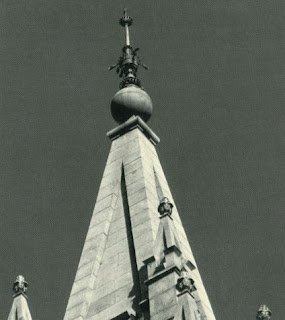
Notably, the six primary spires on the Salt Lake Temple are the symbolic equivalent of our Christmas tree. A round ball, the equivalent of a star on our tree, tops their conical shape.


Indeed, one of them bears an angel in place of the star, just as do many of our Christmas trees.


Just as the image of the star and the angel are interchangeable in ancient traditions, so too in modern Christmas tree decoration and temple iconography.

In Europe as well as in Asia, the Sacred Tree was considered to be the living image of the axis mundi or "Axis of the World," a figurative or imaginary still point or vertical shaft around which the world turns.

The North Star, Polaris, is the celestial placeholder for that sacred spot in the sky. It’s the only star in the sky that never moves. Throughout the night and year, all the stars move in circles around Polaris, called the pole star since it is located directly over the Earth’s north pole. As the night progresses, the stars will slowly move from east to west, circling around the pole star, due to the Earth’s rotation. Hence, all ancient cultures held that spot in the sky as sacred.

They also associated the pole star with the World Tree or Tree of Life and the central axis of the universe. In tradition, the top of the World Tree touched the North Star. This is the true meaning of the star on top of the modern Christmas tree, and also the reason that Santa makes his home at the North Pole in Christmas tradition.

In South Asia, traditions concerning the enchanted World Tree or World Axis have taken somewhat different forms. And yet, despite the differences, certain common patterns persist. The sacred tree, the vertical World Axis or stambha or stupa and the generous spirit from the far north are all features of pan-Indian culture that derive, most probably, from the same traditional sources as those of Western cultures.


The precedence of the cosmic center among the great ancient cultures has been noted and documented by many scholars. Almost a hundred years ago, William F. Warren, in his groundbreaking work, Paradise Found, identified the celestial pole as the home of the supreme god of ancient races. "The religions of all ancient nations ... associate the abode of the supreme God with the North Pole, the centre of heaven; or with the celestial space immediately surrounding it."

In a general survey of ancient language, symbolism, and mythology, John O’Neill (Night of the Gods) asserted that mankind’s oldest religions centered on a god of the celestial pole.

Latter-day Saints should note that, in keeping with ancient astral tradition, the constellation Ursa Major or Big Dipper, the traditional locator for the Pole Star, is depicted on the west wall of the Salt Lake Temple where it is positioned so as to ‘point’ to the northern sky and the polar star, Polaris.


Also seen immediately above these star stones are the Saturn Stones, circles with a ring.

This is no mere oddity or casual coincidence. As Nibley pointed out, the temple is an earthly replica of the heavens. It puts the uniquely modern temple squarely in the heart of ancient tradition — especially Christmas tradition. Certainly, it speaks to the reverence which modern temple builders placed on the star Polaris and its traditional role in ancient cultures worldwide.

Though it may seem completely odd to us, the Romans, who called themselves "Saturnians" and celebrated Saturnalia at the winter solstice, also placed their god Helios at the heavenly pole where Polaris now sits. In their pantheon, Helios was called the central sun, the axis of the celestial revolutions. But, Helios was also called Saturn.

All Greek astronomical traditions agreed that their god, Kronos, was originally the planet Saturn. What is now the sixth planet from the Sun stands at the center of the Greek paradise myth. According to their traditions, Kronos, the planet Saturn, ruled the heavens for a period, presiding over the Golden Age, then departed as the heavens fell into confusion.

Likewise, the Assyrians placed their central sun, Shamash, at the pole. But, they also asserted that Shamash was Saturn.

A stunning example of the polar Saturn is provided in Chinese astronomy, where the distant planet was called “the genie of the pivot” (Santa Claus?). Saturn was believed to have his station at the pole, according to the eminent authority on Chinese astronomy, Gustav Schlegel. In the words of Leopold deSaussure, Saturn was "the planet of the center, corresponding to the emperor on earth, thus to the polar star of heaven."

Finally, the Egyptian god Atum-Ra was said to be a central sun, standing atop the world pole. But, their traditions also depict Atum-Ra as Saturn.

As peculiar as this tradition of Saturn at the pole may appear to us, it has been acknowledged by more than one authority, including Leopold de Saussure. The principle also figured prominently in the recent work of the historian of science, Giorgio de Santillana and the ethnologist Hertha von Dechend, authors of Hamlet’s Mill. According to an ancient astronomical tradition, the authors suggest, Saturn originally ruled from the celestial pole.

It is also known that Latin poets remembered Saturn as god of "the steadfast star," the very phrase used for the pole star in virtually every ancient astronomy.

Manly P. Hall, noted authority on ancient belief systems wrote, "Saturn, the old man who lives at the north pole, and brings with him to the children of men a sprig of evergreen (the Christmas tree), is familiar to the little folks under the name of Santa Claus."

Santa Claus, descending yearly from his polar home to distribute gifts around the world, is a muffled echo of the Universal Monarch, Saturn, spreading miraculous good fortune. But while the earlier traditions place this sky god at the celestial pole, popular tradition now locates Santa Claus at the geographical pole — a telling example of originally celestial gods being brought down to earth.

The origin of Santa Claus imagery can be readily seen in Egyptian religious art. Atum/Ra, the god of the north, stands in his celestial boat, bark or ark, pulled across heaven by servants or souls.


The Egyptian image metamorphosed over time and across several ancient cultures to become, in Nordic cultures, the old man of the north, Santa Claus, pulled in a sleigh by reindeer.

It is at this point that these ancient traditions most specifically intersect with modern temple symbolism.

Most Saints know of the Sun Stones depicted on the Salt Lake Temple. Given the traditions of the Egyptians, Assyrians and the Romans, it seems likely that those Sun Stones, like the Big Dipper, were placed there in recognition of the ancient traditions, which declared that a "sun" was once positioned at the celestial pole.

Additionally, most Saints are unaware that there are Saturn Stones in the Salt Lake Temple. The original architectural renderings of the building by Truman O. Angel, clearly depicted a planet with two rings around it at the top of each south wall buttress.


Note that there is no such symbol on the Salt Lake Temple as it was finally erected, as we see it today. Instead, a repeated symbol (called a 'frieze' in architecture) of a circle with a ring around it (the traditional symbol for Saturn) was installed to replace the original icon. This circle frieze can be seen on the parapet stringcourse, immediately below the three towers at each end of the temple, and is still referred to in LDS literature and tradition as Saturn Stones.

Just as the Egyptians, Greeks and Romans worshiped a central sun that we, today, can identify from cross-cultural comparisons as Saturn, the various 'stones' on the Salt Lake Temple also celebrate that connection, once again correlating temple iconography with ancient, traditional symbolism that gave rise to our Christmas traditions.

It’s no stretch to see that modern prophets would employ the ancient, traditional symbolism of antiquity on a modern temple. The fact that they would properly use the traditional, sacred, religious icons from the past serves to strengthen Joseph Smith’s and Brigham Young’s claims to being prophets of God.

So, what should we make of Christmas with all its pagan symbolism and motifs? If modern prophets chose to memorialize the symbols of ancient traditions in latter-day temples, then who are we to reject those same symbols and traditions in our Christmas celebration?

© Anthony E. Larson, 2005